Writing
The five tracks under everything I cut
On a 400mm shot the camera audio is wind and my own breathing. So the whole soundtrack gets built, and this is the layout I build it on.
Shoot wildlife long enough and you learn that the camera gave you nothing. On a 400mm shot the on camera audio is wind and me breathing. So I mute all of it and build the entire soundtrack from scratch.
That sounds like more work than it is, once you have a layout. Here's mine.
Five tracks, always the same
A1 is sync. Camera audio, dialogue, anything recorded at the same moment as the picture. It lives alone so I can mute the whole lot without touching anything I designed.
A2 is ambience. The sound of the place, running unbroken.
A3 is whoosh. Motion and transitions.
A4 is impact and sub. Landings, hits, weight.
A5 is music.
Same five, every time, in that order. The point isn't the names, it's that I never have to think about where something goes.
Decide which way round you're working, first
Before anything else: is the music leading, or the picture?
Montage, adventure, wildlife, most of what goes on YouTube, that's music led. The track goes down before I cut a single frame, and the picture gets cut to it. Narrative and documentary are the other way round, story dictates the cut and the music gets scored to it afterwards.
Almost everything I make is music led, and getting this backwards is why a montage feels merely accompanied instead of locked in.
The trick that saves the most time
Lay the music on A5. Play it, and tap M on every beat you might cut on.
Resolve drops a marker at the playhead while it plays, so the whole track takes one pass in real time. No counting bars, no maths. Listen once, tap along, and the grid is drawn. Then cut picture to those markers and they snap, so clips land on beats without you measuring anything.
Ambience never cuts with the picture
This is the one that fixes dry edits, and it's the one people get wrong.
The bed runs unbroken across the whole timeline. The shot changes, the place doesn't. That's the entire mechanism, and it's why a sequence stops feeling like separate clips stuck together.
Mix it quieter than instinct says, around 35 to 45dB down. If you can clearly hear it, it's too loud. You should only notice it when you mute it.
The whoosh leads the cut
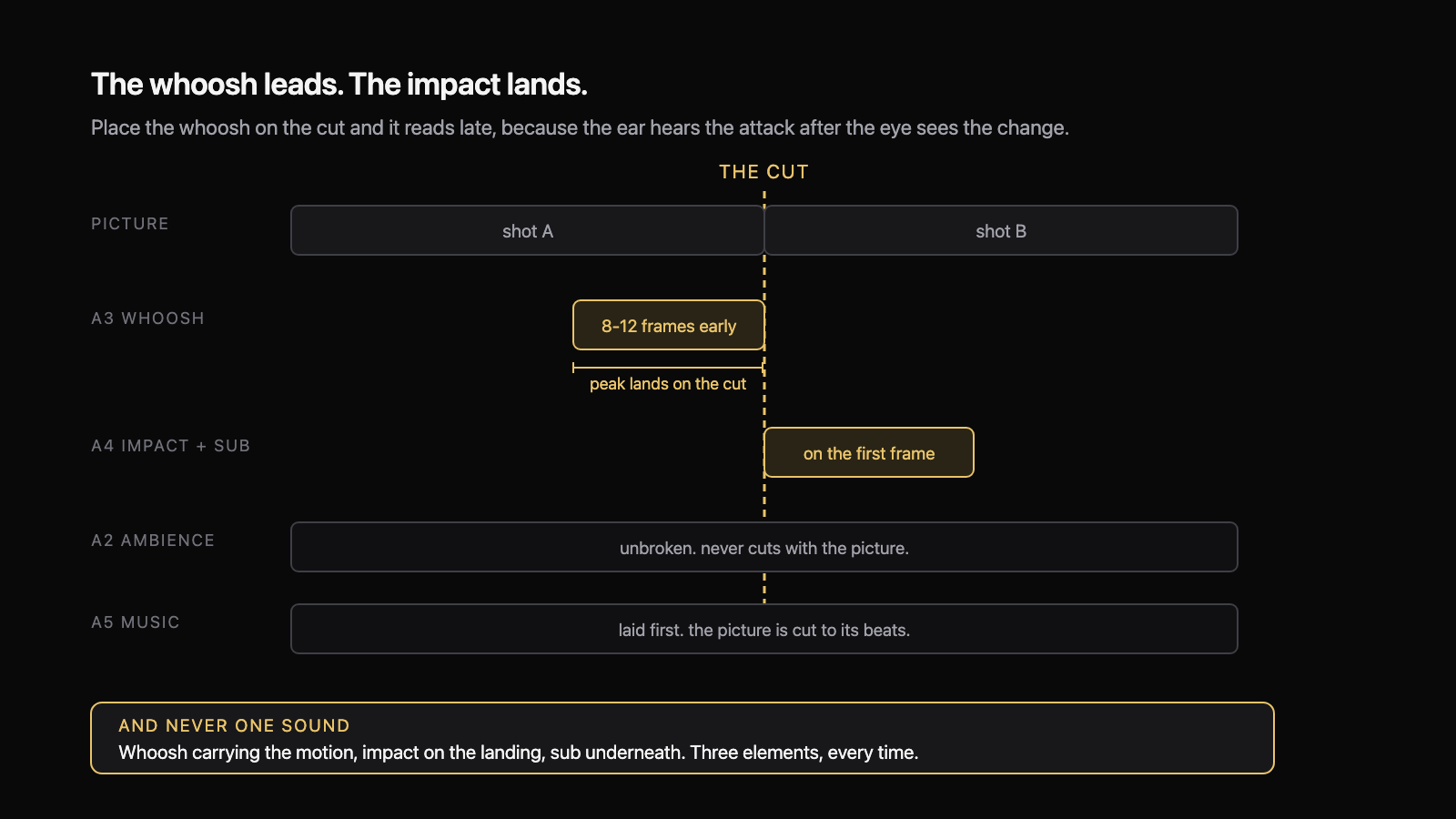
A whoosh starts 8 to 12 frames before the cut, so its peak lands on the cut point.
Put it on the cut and it reads late, because your ear hears the attack after your eye has already seen the change. That one rule separates good from amateur more than any plugin does.
And fit it to the motion. Stretch it, pitch it. Faster and higher for a whip pan, slower and lower for a push in. A two second whoosh on a twelve frame cut is the most common mistake there is. The library file is raw material, not a finished element.
One sound is never one sound
The impact sits on the first frame of the new shot. Not before, not after.
And a whoosh with no impact behind it sounds thin no matter how good the file is. Three elements, every time: whoosh carrying the motion, impact on the landing, sub underneath for the weight.
Where the music has a beat, put the impact on it. If an impact and a downbeat disagree, move the impact. Never the music.
The spread is the production value
Sync peaks at -12 to -6. Ambience sits at -35 to -45. Whoosh -18 to -12. Impact -10 to -6, which makes it the loudest thing after dialogue, and it's meant to be. Music -20 to -15 under dialogue.
Look at the gap between the ambience and the impacts. That's about 30dB, and that spread is the production value. Flatten it and the whole thing sounds like a slideshow.
Mix to -14 LUFS integrated with a true peak of -1dBTP. YouTube normalises to roughly that, so anything louder just gets turned down and you lose the dynamics you fought for.
Record your own ambience
Library ambience of a Florida marsh is almost always a different marsh on a different continent. A wild track is the highest value thing you bring home besides the footage, because it is the actual place.
I use a Zoom H6 with the stereo capsule, which is the right tool and already in the bag. Sixty seconds minimum, three to five minutes is better, and nobody moves. Announce it and everyone stands still, because a foot shifting is the take gone.
Mine isn't 32 bit float, so gain actually matters. Manual gain always, peaks around -20 to -12, limiter off. A limiter triggering once in five minutes leaves an audible swallow exactly where you wanted your loop point. Slate it at the end rather than the start, so the usable material begins at frame zero instead of after your voice.
The only thing worth buying is a furry windjammer. The foam in the box isn't enough outdoors even on a still day, and one gust ruins a five minute take that you won't discover until you're in Resolve.
And one more thing about macro
On a macro shot on a log or in a tank there's no real ambience at all. So you invent one. A very low insect bed and faint water, around -40dB.
Nobody consciously hears it. Without it the shot sounds like it was filmed in a vacuum, which it was.
Everything I mention here is on my gear page.