Writing
You can't stabilise water
Why ocean footage defeats every stabiliser, and the only thing that actually fixes it.
My first couple of days after moving to Florida I shot an alligator with a lot of moving water around it. I never got that shot stable. Not with Resolve, not with Warp, not with anything I tried afterwards.
It took me a while to understand that the software was not failing. It was doing exactly what it is built to do, with material it was never built for.
What a stabiliser is actually doing
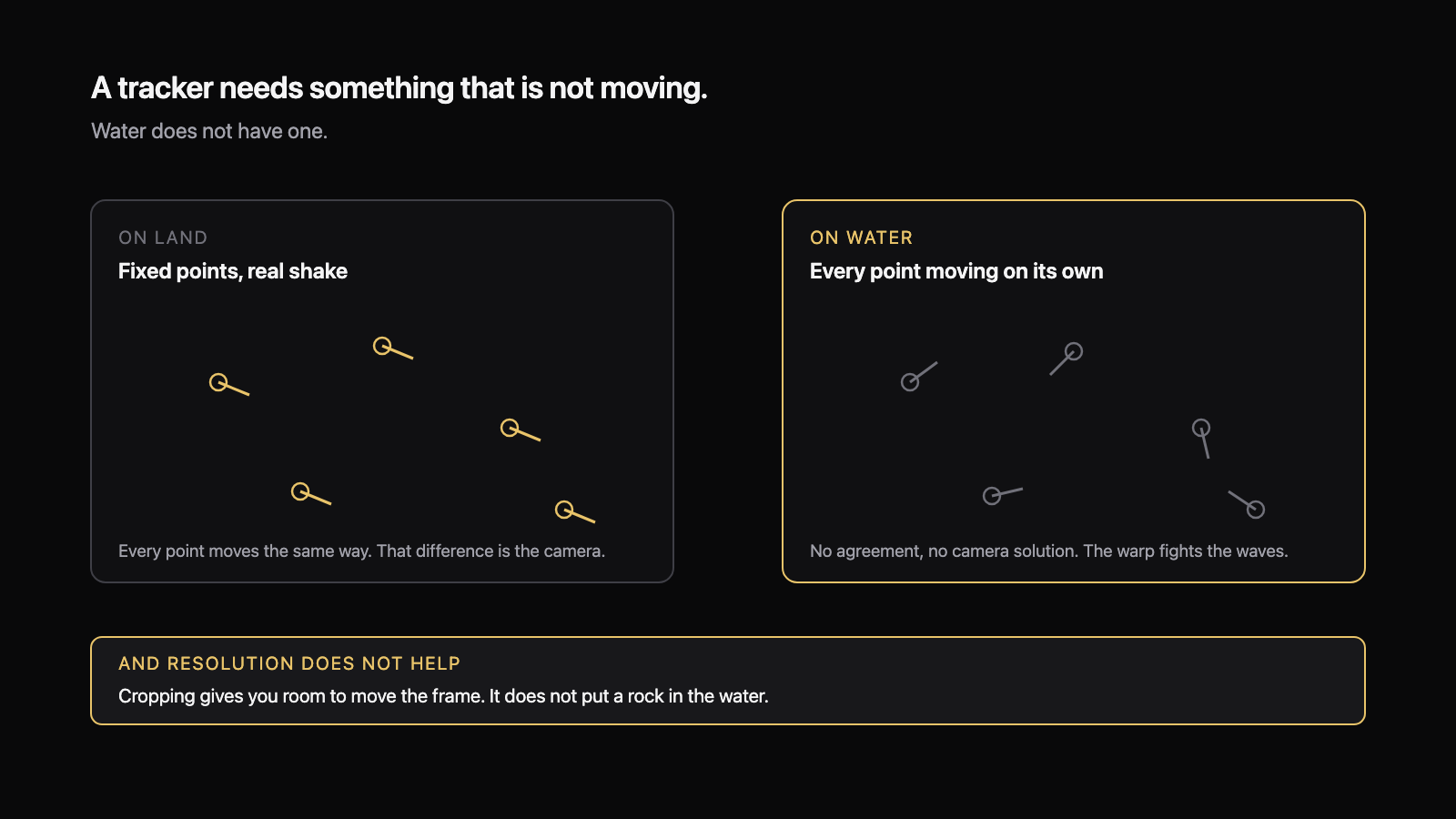
Every image based stabiliser works the same way underneath. It finds features in the frame, assumes those features are standing still in the real world, measures how they move from frame to frame, and calls that difference camera shake. Then it warps the picture to cancel the difference out.
The whole method rests on one assumption: that the things it is tracking are not moving on their own.
Water breaks the assumption
Water has no fixed features. A wave crest is gone a moment later. A glint is a new glint. Foam moves, swell moves, the surface moves at a different speed from the thing floating on it.
So the tracker locks onto motion that has nothing to do with your camera, decides it was shake, and warps the frame to remove it. That is why stabilised ocean footage breathes, or slides along with a swell, or has a horizon that will not sit still. You did not remove shake. You added a second motion on top of the first.
Worse, it often looks fine on the first pass and wrong the moment you watch it twice.
More resolution does not save you
The obvious thought is that shooting bigger fixes it, because you can crop in and give the stabiliser room to work.
It does not. Cropping gives you room to move the frame around. It does not give the tracker a single fixed thing to hold onto, and that is the actual problem. Shooting 8K does not put a rock in the water.
What actually works
A tripod. That is the honest answer and it is not a satisfying one.
If the camera genuinely did not move, there is nothing to stabilise and nothing for a tracker to get wrong. The water moves, which is what you wanted, and the frame stays where you put it.
This is one of those problems where the fix is upstream of the edit. No amount of post is going to reconstruct information that was never in the file. If the shot matters and there is water in it, put it on sticks.
Everything I mention here is on my gear page.